
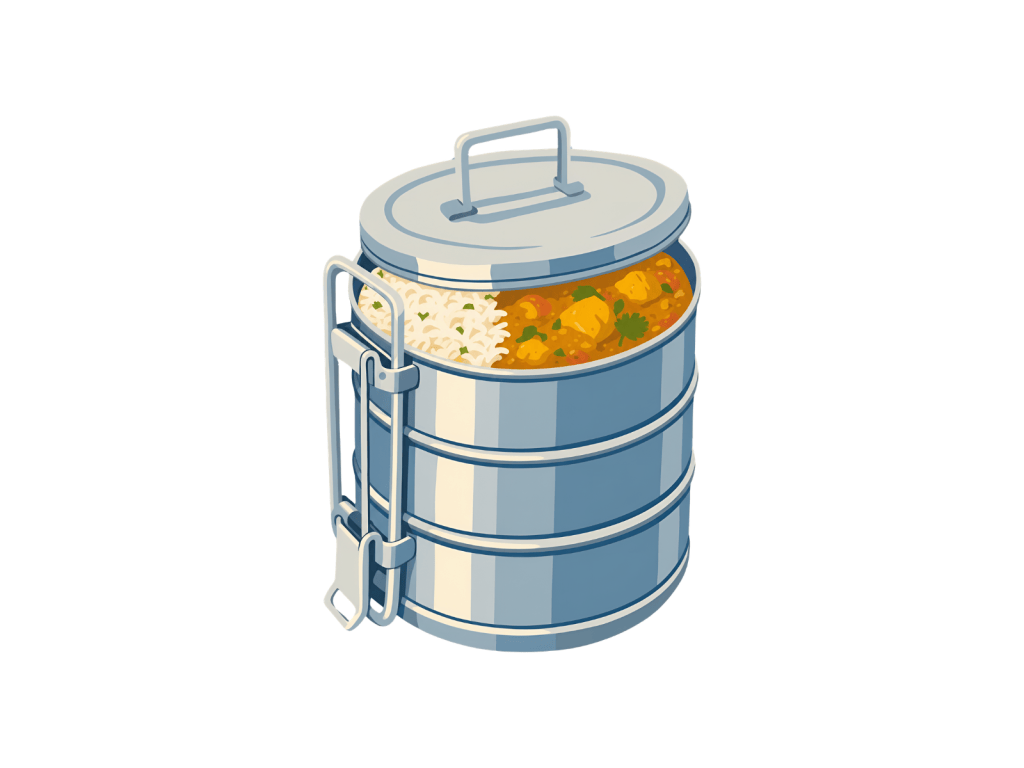
Lunchtime at work begins at 1 pm. Her dabba is delivered by then, hot and delicious, without fail.
An ordinary stainless-steel container with a complicated lock system that took the writer years to figure out on her own. It’s usually roti-sabzi and a bowl of plain yoghurt, which is a typical Indian lunch. Some colleagues brought lunch from home, while others ordered food delivery. Food delivery also includes single-use cardboard boxes and plastic cutlery, questionable cooking and hygiene practices and a battle between taste and health. We hear of top restaurants closing down for malpractice, but the writer has never contracted food poisoning from her dabba, served five days a week for two years.
The Dabba System: Mumbai’s 136-Year-Old Legacy
If you have lived in the City of Dreams, you will love the history and culture of dabbawallas here. The dabbawalla system runs on trust, accuracy and planning. It’s not a standalone business with a Chief Executive Officer in a plush office, but rather a thriving community that ensures home-style lunches reach us by 1 pm every day, through natural or man-made disasters. Though one might argue that food delivery systems are convenient, our options barely compete with our homely lunchboxes packed with care and delivered without fail except in emergencies.
Dabba systems pride themselves on handwashing utensils and cooking food with less oil, fewer spices and no additives. Lunches were delivered to the office-goer’s home, but the writer’s lunch used to come from headquarters itself. She had the owner’s phone number, usually to inform him when she was on leave. It was simple Maharashtrian-style vegetarian food, and she didn’t have to battle decision fatigue and delivery timelines. She remembers paying only INR 800 per month for her dabba in Mumbai. So, why can’t this sustainable, affordable and hygienic model work everywhere in India?
The Japanese bento – pioneered using aluminium boxes in the early twentieth century – offers a structure ideally designed for eating a healthy lunch.
Bee Wilson, First Bite: How We Learn to Eat
Delving Deeper Into Health, Affordability And Sustainability
Though the dabba system originated in Mumbai, the writer believes it should be implemented in other Indian cities. She remembers a couple of classmates in Kolkata as paying guests, paying for both food and lodging. They received unappetising food, but their other options were takeout or a dinner at the nearby biryani stall. This was a health hazard due to low nutrition, and it also meant added costs, dependence on microplastics and greasy food. As we all know, this leads to high blood pressure, blood sugar and cholesterol problems in future.
Stainless-steel tiffin boxes are durable, stackable and airtight as long as we fasten them. It took the writer months to learn how to lock the box properly, but it was worth the zero-waste, complete-health policy. Indians crave their traditional meal: rice or roti (carbohydrates), lentils (protein), vegetables (vitamins and minerals) and pickle and yoghurt. Stacking these items in steel containers preserves their aroma, temperature, flavour and texture. That’s why Saajan Fernandes enjoys receiving his mixed-up dabbas and notes from Ila Singh in the critically acclaimed The Lunchbox (2013).
Though one might argue that food delivery systems are convenient, our options barely compete with our homely lunchboxes packed with care and delivered without fail except in emergencies.
Aadrita Chatterji
Indian Workplaces Should Uplift Dabba Systems Everywhere
Although much of the world has returned to brick-and-mortar offices, some of the workforce continues working from home. Those who go to work miss their home-cooked lunches, while those who stay at home worry about what to cook. Even college students sick of hostel food want something delicious, and of course, healthy. As we see here, other parts of India have an equal demand for Mumbai’s dabba system. Even if we don’t mind cooking at home every day, it is okay to book a dabba when we’re unwell, busy, or we don’t feel like it.
Hostels, guesthouses and workplaces must build communal dabba systems with proper microwaves, dishwashing sinks and pantries. The writer was fortunate to have such facilities where she worked, but not everywhere else. A mobile-based subscription platform is another major step forward for hybrid and remote workers living alone, or when they cannot buy groceries or are too sick to cook. India is a labour- and digitally intensive country, and a communal lunch system deserves more thought, planning and investment than more food delivery. Moreover, it continues Mumbai’s 136-year-old dabba legacy beyond Maharashtra.
As workplaces become more human-centric, employee comfort includes the basics: food, water and safety. While the simplicity of dabba systems cannot compete with the glamour of food delivery systems, it is certainly sustainable. It reminds us that ‘dead’ food in a plastic box greased with oily, heavy spices and divided among colleagues is never a meal. Instead, ‘living’ food should be freshly cooked and packed to share with a community that believes in eating and sharing different cultures through gastronomy. Dabba systems all over India can make that happen.
At least, that’s how the writer believes workplace lunches should be.


Leave a comment