
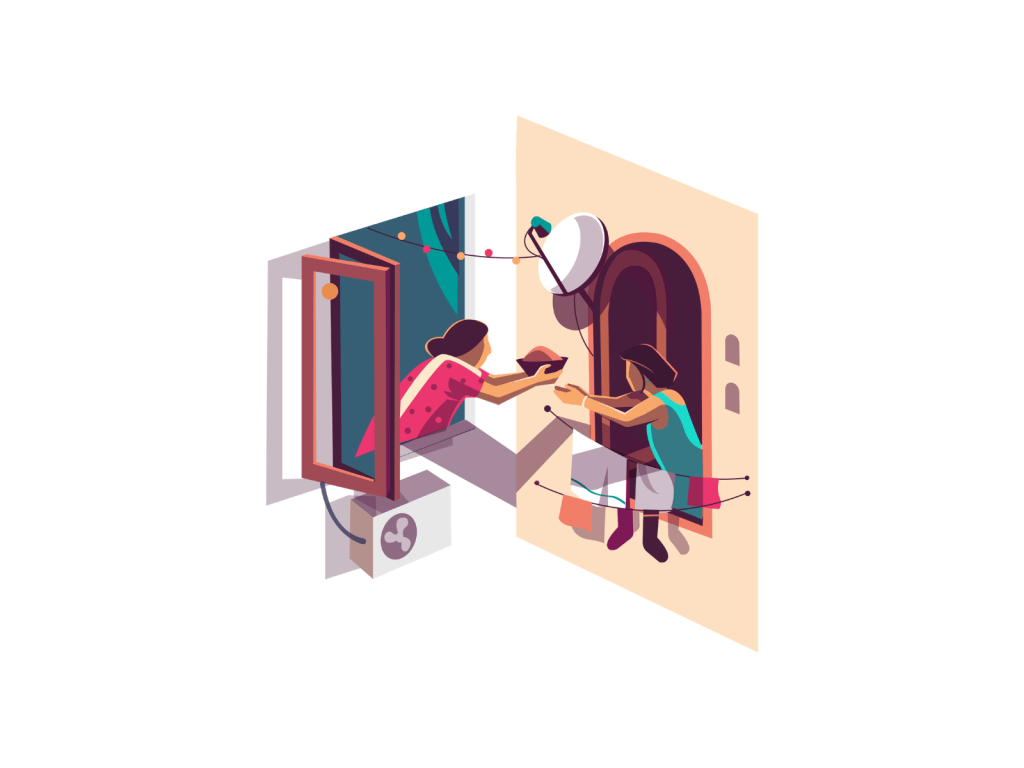
Most of us have never spoken to the person living next door.
In India, people live in apartments and bungalows. Though the housing style has changed over the years, the Indian-ness of our neighbourhood lives on only in the village. We remember our grandparents talking about the good old days, when guests showed up on the front porch at will. Men gathered under the banyan tree to discuss business, politics, and land, while women visited each other’s homes, shared recipes and advised on family conflicts. These slowly disappeared as cities became more urbanised, families became smaller, and life became busier.
How Has The 21st Century Welcomed The Next-door Neighbour?
Though the neighbourly feeling continues in the city’s semi-rural and rural areas, the cities are slowly losing any chance of spontaneous social interaction. It is common for people to park their cars and slip into the elevator, hoping that nobody sees them. People want greater privacy and security when designing their homes, whereas open courtyards and front verandahs were once expected and appreciated in traditional Indian homes. Most people live two extremes: one knowing nothing about their neighbour, and the other extremely interested in everyone’s lives.
Of course, one cannot simply blame the need for privacy and security for a socially depleting society. Modern life, in one word, can be exhausting. Most homes now run on a double income, demanding working hours and longer commutes, leaving families with almost no time and energy to spend on themselves, let alone their neighbours. Conversation, although cautious and physically distant, was a relief during the COVID-19 pandemic: people were cooped up in their homes wanting to talk about something other than the news.
I’m the neighbourly sort to them that’s neighbourly. However, it seems there are folks around that don’t know the meaning of the word nor the sentiment behind it.
Will Colt, Big Sky Marshal: A Classic Western Adventure Series (Book 4)
― David MacLean
The Silent Neighbour Versus The Nosy Neighbour
Once upon a time, it was common for the women of the house to come out on the porch. They shared tea, help, and family management strategies. As people moved to cities and houses changed into apartments, they desired autonomy over people-pleasing. Soon enough, they found that creating their own world saved them from unnecessary gossip, unwanted guests and favours, and boundary violations. Slowly and steadily, they stopped speaking to their neighbour unless absolutely required. They would rather order yoghurt urgently than ask their neighbour for a bowl.
People became hyper-independent as modern technology and convenience introduced remote work, smart home security and delivery applications. Instead of thinking about the community, they also started thinking about what benefited themselves and their loved ones. This wasn’t an act of cold selfishness, but also a reaction against the interfering neighbour of the past that had an opinion on all family matters. They wanted to remain cordial, but also maintain their personal space and dignity, which was somewhat missing in the idealised ‘neighbourly neighbourhood.’
Modern life, in one word, can be exhausting.
Aadrita Chatterji
Can We Maintain A Balance Between A Friendly Wave And Autonomy?
Though we avoid meeting our neighbours in the elevator, and prefer to take the stairs instead, the ‘next-door neighbour’ isn’t as bad as we make out to be. Our neighbours, especially the good ones, welcome us home when we’re back from a long day at work. They are the people who will make us warm soup and meals when we’re sick, and assure our parents living in another city that we are completely fine. They support us when we demand what is right, because we are the first generation given a chance to speak up. They care for us, though we don’t share blood.
The right kind of neighbours build a community we so dearly lack in our modern life, who make us feel acknowledged in a life lived alone. Though we have a choice, we don’t have to overshare our lives with them. Simple micro-conversations, such as a cheerful hello and wave, a genuine smile and a wave, work their magic too. Simple acts of goodwill, such as taking their parcels, sharing food and inviting them for coffee one rainy evening. Even with the difficult neighbours, don’t be rude and gossipy about them. Respect their preference to stay alone, but never hesitate to help them.
When we say neighbours, we often compare them to our friends and colleagues. Our friends like us because we have shared interests, and our colleagues like us because we share a work goal. Our neighbours need not like us because we share a building or a street. A good neighbour does not demand shared holidays, dinner parties and best-friend dynamics. If they do become close to you over time, that, my friend, is a privilege. Otherwise, simple recognition, civility and mutual goodwill are good enough to be a good neighbour yourself.
After all, we don’t live in blocks of stone and brick. We live in a living, breathing community.


Leave a Reply